Friday, 20 June 2014

Pandan Kaya (Coconut Jam)


Kaya. In Malay it means rich. It also describes this custard-like spread that I love. Its great on bread (especially thick fluffy white bread, toasted) and brioche, and it is even great on ice cream. In Malaysia if you go to Kopitiams, they will serve big thick slices of toasts with Kaya that is eaten with soft boiled eggs.

It is a rather time consuming process, but it was worth it because:
a) I cannot get Kaya here in Athens, 
b) They taste so much better when you make it yourself, 
c) I love the 'flavour' and scent of pandan but I absolutely hate that pandan kaya is usually green in colour when its store-bought (It reminds me of radioactive goo and nope, nope. I can't)


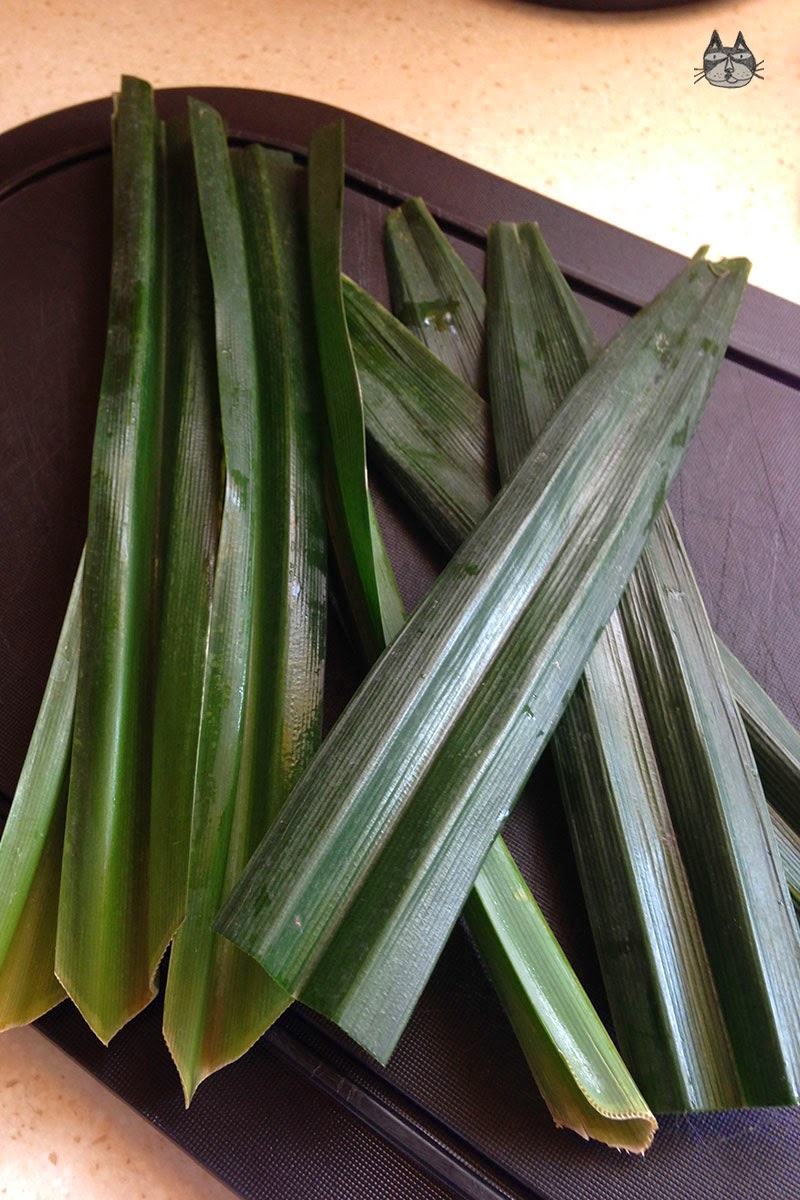
And what is pandan? Also known as screwpine leaves, its a very heavily scented leaf that is used in a lot of Malaysian and Thai cooking - from savouries to sweets. You can find them at Asian Food stores (I found mine at Salamat - check out my where to buy page.)


Ingredients:

500ml of coconut milk
250ml of coconut cream
5-8 pandan leaves
200g of granulated sugar
250g of fine brown sugar or gula melaka
10 eggs

Preparation:

1. Slice the pandan leaves into small slices. In a pot, on low heat, boil the coconut milk with the white granulated sugar and pandan leaves until only half of the liquid remains (it becomes thick). Stir occasionally to prevent burning or lumps appearing. Your kitchen will start smelling wonderful about now.


2. Leave it to cool. Remove the leaves.
3. Cream the eggs and the brown sugar or gula melaka until its a golden creamy mix.
4. Add in the cool scented and thick coconut milk (which should be about 250ml by now) and the coconut cream. Stir to mix thoroughly.
5. Use the double boiler method: In a pot, add water to boil. Balance a bowl on top, making sure it doesn't touch the water at the bottom. Gently heat up the custard mixture, stirring occasionally until it has turned thick and smooth. It will take quite some time - I would say an hour and a half to 2 hours for this amount of kaya.


6. Leave to cool and store it in jars. It can last for about a month to 7 weeks in the fridge.
7. If you want the kaya to be smoother, you can blend it using a hand blender before storing.
8. Serve it like you would serve jam or marmalade. 


My version of a Kopitiam breakfast - English Breakfast tea, with a soft boiled egg (with pepper and soya sauce!), some sliced apricots and pandan kaya toasts!


Tuesday, 17 June 2014

Canard a l'orange with five spice


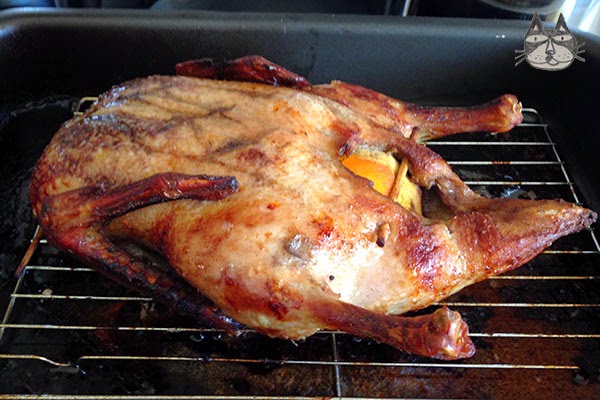
This past weekend, while browsing at the supermarket, I found duck - a whole duck - giblets and all. And I was reminded of a meal I had while I was in Paris at Place de la Madeleine. It was a gorgeous Duck a l'orange, and it was exquisite. But duck also reminded me of the chinese restaurants back in Kuala Lumpur with its famous Peking Duck, and its crispy skin that you roll in pancakes and plum sauce. So I thought, lets marry the 2 together, and see how it goes? (It went well!) Also, I didn't have hoi sin (plum) sauce at all and it was the weekend, but I had oranges... so... adapt!

I marinated the duck overnight in the fridge, so this is another one of those 'prepare one day in advance' recipes that I love to make. Also, try to find good oranges - sweet ones are better. I found 'juicing' oranges and they make the sauce taste great.

Ingredients:

1 whole duck, approx. 2 kg

Stuffing:
The zest from 1 orange and 1 lemon
1 star anise
Salt and pepper

Star Anise


Marinade:
Juice the orange and the lemon (from the stuffing).
2 heaped tsp of Chinese Five Spice
1 tbsp of honey
Salt and pepper

Sauce:
1 orange: juice, and julienne the zest
1 tsp of Worcestershire sauce
1 tsp of honey
1/2 glass of red wine
(Plus the juices after you have roasted the duck)

What you will need:
A roasting pan with a wire rack
2 wooden skewers, soaked in water for 20 minutes (or if you know how to sew/truss, a kitchen needle and thread and string)


Preparation: 

1. Prepare the duck. Clean it, remove the extremely fatty parts/excess flaps. If you have bought it from the butchers, you can get him to prepare it for you.
2. Make sure the duck skin is dry and not slippery to the touch. Place the duck in a bowl that is big enough to hold it (and one that you can cover). Make zigzag cuts on the skin, especially at the top and the breast of the duck so as to let the fat sizzle out when it cooks. Don't pierce into the meat, just lightly score to the fatty layer of the skin. Season generously on the inside (cavity) and the outside of the duck.
3. With a wooden skewer, close the gap at the neck end of the duck, and trim off the edges. (Or sew it if you know how to.)

4. Stuffing: Slice the zest into chunks (not too small) and insert into the duck cavity with the star anise. I also saved the leftover fruit of half an orange after I juiced it. I used it as a 'cork/stopper' of the cavity. With the other wooden skewer, close the gap of the cavity as best as you can (again, sew if you know how to). This is the important part that I couldn't do because I don't know how to, and I don't have kitchen string. Truss the duck (bind the legs and wings together and tie them up). But I didn't and it turned out ok.

5. Marinade: Rub the 5 spice mix all over the duck, concentrating on the zig zag cuts you just made earlier. Set aside.
6. In a saucepan, reduce the orange and lemon juice with the honey until it becomes syrupy in texture. Season the marinade. Leave to cool. Then rub the marinade all over the duck.
7. Cover, and leave to marinade in the fridge overnight (at least 12 hours but no more than 24.)

The Next Day

1. Take the duck out of the fridge at least 30 minutes before roasting to let it get to room temperature. This is also the time for you to rub the sticky marinade all over the duck from the bottom of the bowl.
2. Preheat the oven to 200 degrees C.
3. Prepare the roasting pan. Have the wire rack ready and make sure you have about 1 cm of water at the bottom of the pan. Put the duck breast side up.
4. Roast in the oven for about 15 minutes. Baste the duck with the fat that has melted at the bottom of the pan.
5. Reduce the temperature to 180 degrees C, and continue roasting for another hour, basting frequently.
6. Then kick up the heat to 200 degrees C again, and roast for another 15 minutes until golden brown (and also to make the skin crispier)
7. Remove from the oven, and remove the wire rack and the duck onto a plate to rest. Remove the skewers/thread/string and remove the stuffing from the cavity.


8. The Sauce: See all that lovely fatty juices at the bottom of the roasting pan? Remove the oozy fat from the top (skim it off). The trick is to tilt the pan sideways and scoop out as much fat off the pan. Once you have done that, scrape the lovely crunchy bits of the roasting pan with your spatula. On medium heat, heat up the roasting pan and add the red wine, all the while stirring and scraping with your spatula. Once it has become thick and gravy like, set aside.
9. In a saucepan, on low heat, add the honey and the Worcestershire sauce and mix. Immediately add the orange juice and cook until it becomes a syrup.
10. Add the sauce from the roasting pan into the saucepan, and stir. Continue stirring and cooking until it has thickened. Add 1 tsp of the julienne zest, stir, and take off the heat.
11. If you want your sauce to be smoother, pass the sauce through a fine mesh sieve. 


To serve:

Carve the duck. Arrange on a plate with the sauce at the side and garnish with the julienne orange zest. Serve it with mashed potatoes, or fries or roast potatoes if you like.


Alternative:
We still had plenty of duck leftover from the day before, so I shredded the duck breast meat and we had them Peking Duck style (I used rice dumpling wrappers here) with matchstick spring onions and cucumbers. I also grilled some mushrooms and used the leftover sauce as an alternative to 'hoi sin'. 


Thursday, 5 June 2014

Mavrodaphne Rabbit


Rabbit. I know, I know, its Thumper. Yes, its also Bugs Bunny. I know for a lot of people, this can be a big no-no. I was once a young-un (yes, if you can believe that) and I remember the shock underlined with a tinge of curiosity when I encountered Rendang Arnab (Rabbit Rendang) at a buffet at Seri Melayu in Kuala Lumpur. I just took the sauce, not the meat, and told myself then that it tasted just like normal rendang. I have an uncle who has pet rabbits and I certainly didn't want to disappoint him by eating his pets.....

Fast forward several years (a few...) and I met the Greek chap who took me out for dinner and I had Rabbit Stifado Stew (in tomato sauce and shallots), and it was.... superb. What is this tasty and lean meat? It is very lean - and as I have been told quite a few times, if humans lived on rabbits (as the only source of protein) we will die. Rabbit meat is so lean, that it doesn't provide us humans with enough fat that we need to survive. Wow.

A few years ago, we received a huge box of rabbit meat as a gift. (Thanks Panos and Josephine!) Yes, rabbit meat. And after making Rendang and Stifado, I had to figure out another different recipe that will go well with the meat. Google schmoogle (I can't find the page anymore!) I found one that used white wine. I didn't have any, but I did have Mavrodaphne. Mavrodaphne is a sweet red wine. Its incredibly yummy. The Greek Orthodox church even uses it as communion wine. 

So I adapted it. And hoped that it would taste nice. And it did taste nice. What a recipe. This is one of the 'marinade the day/night before and cook in the oven' lovelies that I love to make.


Ingredients: (serves 4-6 people, or 1 husband, cat, and me for 2 days)

1 Rabbit, cut into pieces, preferably 8 or more. (approx. 2kg)


Marinade:
75ml of olive oil
Juice of 1 lemon and zest
3 tbsp of light soy sauce
4 garlic cloves, lightly bashed
1 tsp of dried rosemary
1/2 tsp of fennel seeds
1 tsp of salt
1 tsp of black peppercorns, lightly crushed
2 bay leaves

Flour, enough to coat the meat.
Salt and pepper
Butter
A (BIG, heh, no, moderate sized) glass of Mavrodaphne wine


Preparation:

1. In a big bowl that you can cover and store in your fridge, add the rabbit pieces (leave the head out - I cook that and the liver, heart etc for my cat Katiki) and mix thoroughly with the marinade ingredients. Cover. Leave in the fridge overnight (or at least 12 hours but no more than 24)


2. Before cooking, take it out of the fridge and let it sit outside until it gets to room temperature. When its not too cold to the touch, take the meat pieces out of the marinade. Rub off the marinade bits (like the rosemary and fennel seeds) as much as you can off the meat with your fingers.
3. Season the flour, and coat the meat pieces, tapping off access flour. Preheat the oven to 180 degrees Celcius.
4. In a frying pan, melt some butter. When its hot, fry the meat pieces until slightly brown. Place the pieces into a baking dish.

5. In the same frying pan, add a small knob of butter, and once its slightly sizzling, add the wine and reduce slightly.
6. Pour the wine sauce over the meat in the baking dish, and cover (with foil).
7. Bake in the oven for approximately an hour and a half. Uncover for the last 20 minutes so that it can get some colour.
8. Serve with roast potatoes. Enjoy! 


What do you do with the leftover marinade?
You can chuck it out. What I like to do is to sieve out the bits, and keep the liquid. The marinade is quite flavourful and lemon-y. I use it when I make Greek Lemon Potatoes (recipe coming soon!) that I serve with the rabbit.